From One Antenna to Many
A single-input single-output link uses one transmit antenna and one receive antenna. Multiple-input multiple-output (MIMO) uses multiple antennas at one or both ends of the link. The purpose is not merely to radiate more power. Multiple antennas provide spatial observations and spatial control.
Depending on the channel and signal processing, MIMO can provide:
- Array gain: combine energy coherently to improve received SNR.
- Diversity gain: send or combine information through independently fading paths.
- Spatial multiplexing gain: send multiple data streams at the same time and frequency.
- Interference suppression: steer energy away from unintended users or cancel interfering directions.
References for this section3
- E. Telatar, "Capacity of Multi-antenna Gaussian Channels", European Transactions on Telecommunications, vol. 10, no. 6, pp. 585–595, 1999.
- T. L. Marzetta, "Noncooperative Cellular Wireless with Unlimited Numbers of Base Station Antennas", IEEE Transactions on Wireless Communications, vol. 9, no. 11, pp. 3590–3600, 2010.
- E. G. Larsson et al., "Massive MIMO for Next Generation Wireless Systems", IEEE Communications Magazine, vol. 52, no. 2, pp. 186–195, 2014.
Does Any Multiple-Antenna Array Count as MIMO?
No. An antenna array describes the physical arrangement of elements; MIMO describes a communication system with multiple independently accessible signal inputs and multiple independently observed outputs. The distinction becomes clear from the number of transmit and receive ports:
| Active transmit ports | Active receive ports | System description | What it can do |
|---|---|---|---|
| 1 | 1 | SISO | One transmitted and one received signal |
| 1 | More than 1 | SIMO | Receive combining or diversity |
| More than 1 | 1 | MISO | Transmit beamforming or diversity |
| More than 1 | More than 1 | MIMO | Diversity, beamforming, or multiple spatial streams |
A panel may contain 64 antenna elements but use a single RF chain and one common analogue weight network. It can form a narrow beam, yet from the baseband signal perspective it may still expose only one transmit input. Conversely, a smaller array with several independently controlled RF chains can create several simultaneous signal dimensions.
For a link to be physically classified as MIMO, both ends must expose multiple antenna ports to the channel model: and . To obtain spatial multiplexing gain, further conditions are required:
- Enough RF chains or equivalent digital dimensions: the transmitter and receiver must be able to generate and observe the intended number of streams.
- A channel with sufficient rank: the propagation paths must create distinguishable spatial signatures rather than highly correlated copies.
- Adequate SNR and channel conditioning: a mathematically non-zero second mode may still be too weak to carry useful data.
- Channel state information: the transmitter, receiver, or both need a sufficiently accurate estimate for precoding, combining, and detection.
- Suitable signal processing: streams must be mapped to the antenna ports and separated at the receiver.
- Antenna isolation and calibration: severe mutual coupling, common hardware errors, or poor calibration can reduce the effective dimensions.
The maximum number of independently recoverable streams is bounded by
Therefore, four transmit antennas and four receive antennas do not guarantee four useful streams. If all paths arrive with nearly the same spatial signature, can be close to rank one. The link is still a MIMO configuration, but it behaves mainly like a beamforming or diversity link rather than a four-stream spatial-multiplexing link.
References for this section3
- E. Telatar, "Capacity of Multi-antenna Gaussian Channels", European Transactions on Telecommunications, vol. 10, no. 6, pp. 585–595, 1999.
- T. L. Marzetta, "Noncooperative Cellular Wireless with Unlimited Numbers of Base Station Antennas", IEEE Transactions on Wireless Communications, vol. 9, no. 11, pp. 3590–3600, 2010.
- E. G. Larsson et al., "Massive MIMO for Next Generation Wireless Systems", IEEE Communications Magazine, vol. 52, no. 2, pp. 186–195, 2014.
The MIMO Channel Model
A narrowband MIMO link is commonly written as
Here, contains the transmitted signals, is the channel matrix, contains the received signals, and is noise. Each entry of describes the complex gain from one transmit antenna to one receive antenna.
The number of useful simultaneous streams is limited by the rank of . A rich-scattering environment can create several sufficiently independent paths and support spatial multiplexing. A highly correlated channel may have many physical antennas but only one or a few effective spatial dimensions.
References for this section3
- E. Telatar, "Capacity of Multi-antenna Gaussian Channels", European Transactions on Telecommunications, vol. 10, no. 6, pp. 585–595, 1999.
- T. L. Marzetta, "Noncooperative Cellular Wireless with Unlimited Numbers of Base Station Antennas", IEEE Transactions on Wireless Communications, vol. 9, no. 11, pp. 3590–3600, 2010.
- E. G. Larsson et al., "Massive MIMO for Next Generation Wireless Systems", IEEE Communications Magazine, vol. 52, no. 2, pp. 186–195, 2014.
Three Ways to Use Multiple Antennas
References for this section3
- E. Telatar, "Capacity of Multi-antenna Gaussian Channels", European Transactions on Telecommunications, vol. 10, no. 6, pp. 585–595, 1999.
- T. L. Marzetta, "Noncooperative Cellular Wireless with Unlimited Numbers of Base Station Antennas", IEEE Transactions on Wireless Communications, vol. 9, no. 11, pp. 3590–3600, 2010.
- E. G. Larsson et al., "Massive MIMO for Next Generation Wireless Systems", IEEE Communications Magazine, vol. 52, no. 2, pp. 186–195, 2014.
Diversity
The same information is transmitted or received through several antenna paths. If one path fades deeply, another may remain usable. Diversity improves reliability rather than increasing the number of parallel data streams.
References for this section3
- E. Telatar, "Capacity of Multi-antenna Gaussian Channels", European Transactions on Telecommunications, vol. 10, no. 6, pp. 585–595, 1999.
- T. L. Marzetta, "Noncooperative Cellular Wireless with Unlimited Numbers of Base Station Antennas", IEEE Transactions on Wireless Communications, vol. 9, no. 11, pp. 3590–3600, 2010.
- E. G. Larsson et al., "Massive MIMO for Next Generation Wireless Systems", IEEE Communications Magazine, vol. 52, no. 2, pp. 186–195, 2014.
Spatial Multiplexing
Different data streams are transmitted through different spatial modes. Under favorable channel conditions, the receiver separates them, increasing peak data rate without adding bandwidth.
References for this section3
- E. Telatar, "Capacity of Multi-antenna Gaussian Channels", European Transactions on Telecommunications, vol. 10, no. 6, pp. 585–595, 1999.
- T. L. Marzetta, "Noncooperative Cellular Wireless with Unlimited Numbers of Base Station Antennas", IEEE Transactions on Wireless Communications, vol. 9, no. 11, pp. 3590–3600, 2010.
- E. G. Larsson et al., "Massive MIMO for Next Generation Wireless Systems", IEEE Communications Magazine, vol. 52, no. 2, pp. 186–195, 2014.
Beamforming
The array weights each antenna signal in amplitude and phase so radiation combines strongly in a desired direction. Beamforming can increase coverage, reduce interference, or serve multiple users with separate spatial beams.
References for this section3
- E. Telatar, "Capacity of Multi-antenna Gaussian Channels", European Transactions on Telecommunications, vol. 10, no. 6, pp. 585–595, 1999.
- T. L. Marzetta, "Noncooperative Cellular Wireless with Unlimited Numbers of Base Station Antennas", IEEE Transactions on Wireless Communications, vol. 9, no. 11, pp. 3590–3600, 2010.
- E. G. Larsson et al., "Massive MIMO for Next Generation Wireless Systems", IEEE Communications Magazine, vol. 52, no. 2, pp. 186–195, 2014.
What Makes MIMO “Massive”?
Massive MIMO uses a base station with many antenna elements—often substantially more elements than simultaneously served users. The exact antenna count is not the definition; the important feature is that a large array gives the network many spatial degrees of freedom.
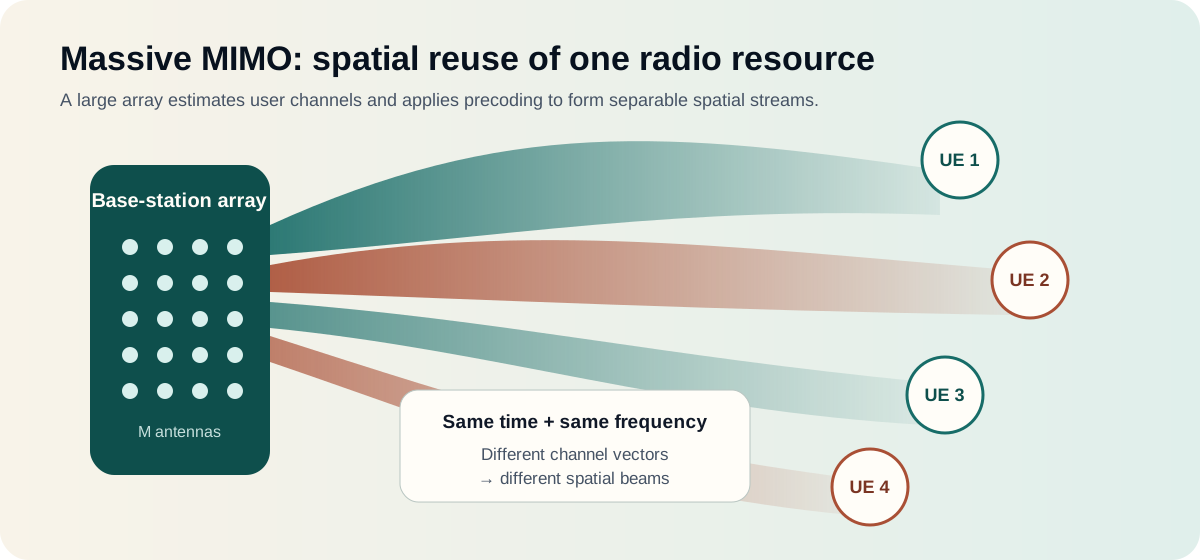
As the number of base-station antennas grows, independent channel variations can average out. This is called channel hardening. User channels may also become closer to orthogonal, a property called favorable propagation. Neither effect is automatic: array geometry, propagation, correlation, blockage, and user placement all matter.
References for this section3
- E. Telatar, "Capacity of Multi-antenna Gaussian Channels", European Transactions on Telecommunications, vol. 10, no. 6, pp. 585–595, 1999.
- T. L. Marzetta, "Noncooperative Cellular Wireless with Unlimited Numbers of Base Station Antennas", IEEE Transactions on Wireless Communications, vol. 9, no. 11, pp. 3590–3600, 2010.
- E. G. Larsson et al., "Massive MIMO for Next Generation Wireless Systems", IEEE Communications Magazine, vol. 52, no. 2, pp. 186–195, 2014.
Multi-User Massive MIMO
In multi-user MIMO, a base station serves several users on the same time-frequency resource. Let be the number of users and the number of base-station antennas. A common design has , giving the base station room to strengthen desired signals while controlling inter-user interference.
References for this section3
- E. Telatar, "Capacity of Multi-antenna Gaussian Channels", European Transactions on Telecommunications, vol. 10, no. 6, pp. 585–595, 1999.
- T. L. Marzetta, "Noncooperative Cellular Wireless with Unlimited Numbers of Base Station Antennas", IEEE Transactions on Wireless Communications, vol. 9, no. 11, pp. 3590–3600, 2010.
- E. G. Larsson et al., "Massive MIMO for Next Generation Wireless Systems", IEEE Communications Magazine, vol. 52, no. 2, pp. 186–195, 2014.
Uplink Combining
The base station combines its antenna observations to detect each user's signal.
- Maximum-ratio combining (MRC): aligns with the desired user's channel. It is simple and provides strong array gain but may leave interference.
- Zero forcing (ZF): separates users by nulling estimated inter-user interference. It needs enough spatial degrees of freedom and can amplify noise when channels are poorly conditioned.
- MMSE combining: balances interference suppression and noise enhancement using channel and noise statistics.
References for this section3
- E. Telatar, "Capacity of Multi-antenna Gaussian Channels", European Transactions on Telecommunications, vol. 10, no. 6, pp. 585–595, 1999.
- T. L. Marzetta, "Noncooperative Cellular Wireless with Unlimited Numbers of Base Station Antennas", IEEE Transactions on Wireless Communications, vol. 9, no. 11, pp. 3590–3600, 2010.
- E. G. Larsson et al., "Massive MIMO for Next Generation Wireless Systems", IEEE Communications Magazine, vol. 52, no. 2, pp. 186–195, 2014.
Downlink Precoding
The base station applies corresponding spatial weights before transmission.
- Maximum-ratio transmission (MRT): maximizes energy toward the desired channel.
- ZF precoding: places nulls toward other scheduled users.
- Regularized ZF/MMSE precoding: avoids overly aggressive inversion when SNR or channel conditioning makes pure ZF inefficient.
References for this section3
- E. Telatar, "Capacity of Multi-antenna Gaussian Channels", European Transactions on Telecommunications, vol. 10, no. 6, pp. 585–595, 1999.
- T. L. Marzetta, "Noncooperative Cellular Wireless with Unlimited Numbers of Base Station Antennas", IEEE Transactions on Wireless Communications, vol. 9, no. 11, pp. 3590–3600, 2010.
- E. G. Larsson et al., "Massive MIMO for Next Generation Wireless Systems", IEEE Communications Magazine, vol. 52, no. 2, pp. 186–195, 2014.
Channel State Information
Beamforming and spatial separation depend on channel state information (CSI). In time-division duplex systems, uplink and downlink channels are physically reciprocal within the channel coherence interval. The base station can estimate the uplink from pilots and reuse that spatial information for downlink precoding after RF-chain calibration.
CSI becomes stale when users move or the environment changes quickly. It is also imperfect because pilots have finite energy and may be reused across cells. Pilot reuse can cause pilot contamination, where an estimate contains components from another user transmitting the same or a non-orthogonal pilot.
References for this section3
- E. Telatar, "Capacity of Multi-antenna Gaussian Channels", European Transactions on Telecommunications, vol. 10, no. 6, pp. 585–595, 1999.
- T. L. Marzetta, "Noncooperative Cellular Wireless with Unlimited Numbers of Base Station Antennas", IEEE Transactions on Wireless Communications, vol. 9, no. 11, pp. 3590–3600, 2010.
- E. G. Larsson et al., "Massive MIMO for Next Generation Wireless Systems", IEEE Communications Magazine, vol. 52, no. 2, pp. 186–195, 2014.
Capacity and Spectral Efficiency
For an ideal MIMO channel, a common capacity expression is
where represents received SNR and is the number of transmit antennas. The determinant reflects the contribution of multiple spatial eigenmodes. If only one strong mode exists, adding streams brings little benefit. If several strong modes exist, capacity can grow substantially.
Massive MIMO therefore improves spectral efficiency by spatially reusing the same bandwidth, rather than by creating new spectrum.
References for this section3
- E. Telatar, "Capacity of Multi-antenna Gaussian Channels", European Transactions on Telecommunications, vol. 10, no. 6, pp. 585–595, 1999.
- T. L. Marzetta, "Noncooperative Cellular Wireless with Unlimited Numbers of Base Station Antennas", IEEE Transactions on Wireless Communications, vol. 9, no. 11, pp. 3590–3600, 2010.
- E. G. Larsson et al., "Massive MIMO for Next Generation Wireless Systems", IEEE Communications Magazine, vol. 52, no. 2, pp. 186–195, 2014.
Practical Limits
- Channel correlation: closely spaced elements or limited angular spread reduce independent spatial information.
- Mutual coupling: elements interact electromagnetically and alter the intended response.
- RF-chain cost and power: fully digital arrays require many converters and transceiver chains.
- Calibration: phase and gain differences across RF chains distort beamforming weights.
- Pilot overhead: channel estimation consumes time-frequency resources.
- Mobility: fast channel variation reduces the useful life of CSI.
- Near-field operation: very large arrays can observe spherical wavefronts, so a user's range as well as angle affects the channel.
Hybrid beamforming reduces RF-chain count by combining analogue phase control with lower-dimensional digital processing. This is common at mmWave frequencies, where arrays are large and RF hardware is expensive.
References for this section3
- E. Telatar, "Capacity of Multi-antenna Gaussian Channels", European Transactions on Telecommunications, vol. 10, no. 6, pp. 585–595, 1999.
- T. L. Marzetta, "Noncooperative Cellular Wireless with Unlimited Numbers of Base Station Antennas", IEEE Transactions on Wireless Communications, vol. 9, no. 11, pp. 3590–3600, 2010.
- E. G. Larsson et al., "Massive MIMO for Next Generation Wireless Systems", IEEE Communications Magazine, vol. 52, no. 2, pp. 186–195, 2014.
A Useful Mental Model
Think of bandwidth as the width of the road and MIMO as adding independently usable spatial lanes within that road. The extra lanes exist only when the channel and signal processing can separate them.
References for this section3
- E. Telatar, "Capacity of Multi-antenna Gaussian Channels", European Transactions on Telecommunications, vol. 10, no. 6, pp. 585–595, 1999.
- T. L. Marzetta, "Noncooperative Cellular Wireless with Unlimited Numbers of Base Station Antennas", IEEE Transactions on Wireless Communications, vol. 9, no. 11, pp. 3590–3600, 2010.
- E. G. Larsson et al., "Massive MIMO for Next Generation Wireless Systems", IEEE Communications Magazine, vol. 52, no. 2, pp. 186–195, 2014.
Takeaway
MIMO turns spatial variation into a communication resource. Massive MIMO extends the idea with a large array that can focus energy, separate users, improve reliability, and raise spectral efficiency. Its real performance depends on channel structure, CSI quality, calibration, and the available RF architecture.
References for this section3
- E. Telatar, "Capacity of Multi-antenna Gaussian Channels", European Transactions on Telecommunications, vol. 10, no. 6, pp. 585–595, 1999.
- T. L. Marzetta, "Noncooperative Cellular Wireless with Unlimited Numbers of Base Station Antennas", IEEE Transactions on Wireless Communications, vol. 9, no. 11, pp. 3590–3600, 2010.
- E. G. Larsson et al., "Massive MIMO for Next Generation Wireless Systems", IEEE Communications Magazine, vol. 52, no. 2, pp. 186–195, 2014.
Complete references and further reading
- E. Telatar, "Capacity of Multi-antenna Gaussian Channels", European Transactions on Telecommunications, vol. 10, no. 6, pp. 585–595, 1999.
- T. L. Marzetta, "Noncooperative Cellular Wireless with Unlimited Numbers of Base Station Antennas", IEEE Transactions on Wireless Communications, vol. 9, no. 11, pp. 3590–3600, 2010.
- E. G. Larsson et al., "Massive MIMO for Next Generation Wireless Systems", IEEE Communications Magazine, vol. 52, no. 2, pp. 186–195, 2014.