Why These Concepts Come First
Every wireless system begins with a signal occupying part of the electromagnetic spectrum. Before studying antennas, MIMO, beamforming, or RIS, it is necessary to understand four connected ideas:
- Frequency tells us how fast a sinusoidal wave oscillates.
- Wavelength tells us the physical distance covered by one cycle.
- Spectrum describes how signal energy is distributed across frequency.
- Bandwidth measures the frequency interval used or supported by a signal or system.
These quantities influence antenna size, propagation loss, achievable data rate, hardware design, and spectrum regulation.
References for this section3
- C. E. Shannon, "A Mathematical Theory of Communication", The Bell System Technical Journal, vol. 27, no. 3, pp. 379–423, 1948.
- 3GPP, TR 38.901: Study on channel model for frequencies from 0.5 to 100 GHz.
- T. S. Rappaport et al., "Millimeter Wave Mobile Communications for 5G Cellular: It Will Work!", IEEE Access, vol. 1, pp. 335–349, 2013.
Frequency and Wavelength
For an electromagnetic wave travelling in free space,
where is the speed of light, is frequency in hertz, and is wavelength in metres.
At 3 GHz, the wavelength is approximately 10 cm. At 30 GHz, it is approximately 1 cm. Higher frequencies therefore allow physically smaller antenna elements, which is one reason large antenna arrays are practical at mmWave frequencies. The trade-off is that high-frequency links usually experience greater path loss, blockage sensitivity, and hardware loss.
| Frequency | Approximate wavelength | Typical context |
|---|---|---|
| 900 MHz | 33.3 cm | Wide-area cellular and IoT |
| 3.5 GHz | 8.6 cm | Mid-band 5G |
| 28 GHz | 10.7 mm | mmWave access, sensing, RIS research |
| 100 GHz | 3 mm | Sub-THz research and very wide bandwidths |
References for this section3
- C. E. Shannon, "A Mathematical Theory of Communication", The Bell System Technical Journal, vol. 27, no. 3, pp. 379–423, 1948.
- 3GPP, TR 38.901: Study on channel model for frequencies from 0.5 to 100 GHz.
- T. S. Rappaport et al., "Millimeter Wave Mobile Communications for 5G Cellular: It Will Work!", IEEE Access, vol. 1, pp. 335–349, 2013.
What Bandwidth Means
If a system passes frequencies between a lower cut-off and an upper cut-off , its nominal bandwidth is
Bandwidth is measured in hertz, not in bits per second. A 20 MHz channel describes a frequency width. Its achievable bit rate depends on modulation, coding, signal-to-noise ratio, channel conditions, overhead, and receiver design.
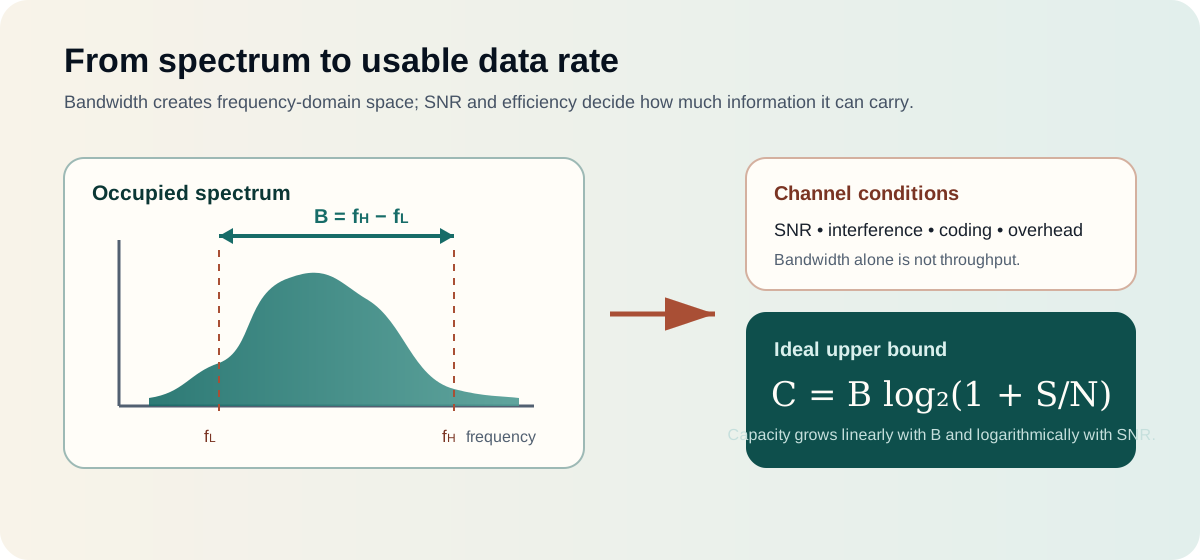
Several bandwidth definitions appear in practice:
- Absolute bandwidth: the complete interval between the lowest and highest non-zero spectral components.
- Occupied bandwidth: the interval containing a stated percentage, commonly 99%, of the transmitted power.
- Channel bandwidth: the spectrum assigned to a radio channel by a standard or regulator.
- Transmission bandwidth: the frequency range that a device or channel can pass with acceptable distortion.
- Effective bandwidth: a context-dependent measure of the portion that contributes meaningfully to system performance.
The definitions should not be mixed. For example, an OFDM waveform can be allocated a nominal channel bandwidth while guard bands and inactive subcarriers reduce the bandwidth that carries user data.
References for this section3
- C. E. Shannon, "A Mathematical Theory of Communication", The Bell System Technical Journal, vol. 27, no. 3, pp. 379–423, 1948.
- 3GPP, TR 38.901: Study on channel model for frequencies from 0.5 to 100 GHz.
- T. S. Rappaport et al., "Millimeter Wave Mobile Communications for 5G Cellular: It Will Work!", IEEE Access, vol. 1, pp. 335–349, 2013.
Baseband, Carrier, and Passband
Information normally begins as a baseband signal. Modulation shifts that information around a radio-frequency carrier so it can be radiated by an antenna.
The carrier frequency controls where the signal sits in the spectrum. The signal bandwidth controls how much spectrum it occupies around that carrier. Two systems may use the same 20 MHz bandwidth at very different carrier frequencies, such as 2.4 GHz and 28 GHz, while having very different propagation and antenna behaviour.
References for this section3
- C. E. Shannon, "A Mathematical Theory of Communication", The Bell System Technical Journal, vol. 27, no. 3, pp. 379–423, 1948.
- 3GPP, TR 38.901: Study on channel model for frequencies from 0.5 to 100 GHz.
- T. S. Rappaport et al., "Millimeter Wave Mobile Communications for 5G Cellular: It Will Work!", IEEE Access, vol. 1, pp. 335–349, 2013.
Bandwidth and the Ideal Capacity Limit
For an additive white Gaussian noise channel, Shannon's capacity formula is
where is the theoretical capacity in bits per second, is bandwidth in hertz, and is the linear signal-to-noise ratio.
Suppose and . First convert 10 dB to a linear ratio: . The ideal capacity is then approximately
This is an upper bound under an idealized channel. A real link achieves less because pilots, control signalling, guard intervals, coding gaps, interference, retransmissions, and implementation losses consume resources.
The formula exposes two useful facts:
- Capacity grows linearly with bandwidth when SNR is fixed.
- Capacity grows logarithmically with SNR, so repeatedly increasing transmit power gives diminishing returns.
References for this section3
- C. E. Shannon, "A Mathematical Theory of Communication", The Bell System Technical Journal, vol. 27, no. 3, pp. 379–423, 1948.
- 3GPP, TR 38.901: Study on channel model for frequencies from 0.5 to 100 GHz.
- T. S. Rappaport et al., "Millimeter Wave Mobile Communications for 5G Cellular: It Will Work!", IEEE Access, vol. 1, pp. 335–349, 2013.
Bandwidth Does Not Equal Throughput
It is common to hear that “more bandwidth means more speed.” That is directionally correct, but incomplete. Four terms should be separated:
- Bandwidth is frequency-domain width in hertz.
- Symbol rate is the number of transmitted modulation symbols per second.
- Data rate or PHY bit rate is the number of coded or uncoded bits carried per second at the physical layer.
- Throughput is the rate successfully delivered across a chosen interface; goodput counts only the useful application payload received correctly.
For pulse-shaped single-carrier signalling, occupied bandwidth and symbol rate are connected by the pulse shape. With a raised-cosine roll-off factor , a common passband approximation is
If each symbol carries coded bits using -ary modulation, the gross modulated bit rate is
Forward-error-correction code rate , the fraction of usable time-frequency resources , and the number of spatial layers give the useful PHY-rate approximation
where already reflects modulation and coding efficiency in bit/s/Hz. User throughput is smaller because scheduling, protocol headers, control signalling, and retransmissions consume part of this rate:
The final application goodput can be lower again after TCP/UDP, encryption, and application headers are removed.
User throughput can also be summarized as
Spectral efficiency is measured in bit/s/Hz. A 100 MHz channel operating at 1 bit/s/Hz carries less data than a 40 MHz channel operating at 6 bit/s/Hz. The wider channel still offers more potential, but only if the link quality and radio design support an efficient modulation and coding scheme.
For example, suppose a 100 MHz carrier achieves 4 bit/s/Hz over two spatial layers, while 70% of resources carry scheduled user data and combined protocol/retransmission efficiency is 85%. An illustrative throughput is
This calculation is an engineering estimate, not a guaranteed speed. The instantaneous result changes with modulation and coding, number of scheduled users, channel quality, traffic demand, device capability, and network policy.
References for this section3
- C. E. Shannon, "A Mathematical Theory of Communication", The Bell System Technical Journal, vol. 27, no. 3, pp. 379–423, 1948.
- 3GPP, TR 38.901: Study on channel model for frequencies from 0.5 to 100 GHz.
- T. S. Rappaport et al., "Millimeter Wave Mobile Communications for 5G Cellular: It Will Work!", IEEE Access, vol. 1, pp. 335–349, 2013.
Coherence Bandwidth and Frequency Selectivity
Wireless channels introduce delayed copies of the transmitted signal. If the signal bandwidth is much smaller than the channel's coherence bandwidth, the channel is approximately flat across the signal. If the signal is wider, different frequency components experience different gains and phases, producing frequency-selective fading.
OFDM handles this by dividing a wideband channel into many narrow subcarriers. Each subcarrier experiences an approximately flat channel, making equalization simpler.
References for this section3
- C. E. Shannon, "A Mathematical Theory of Communication", The Bell System Technical Journal, vol. 27, no. 3, pp. 379–423, 1948.
- 3GPP, TR 38.901: Study on channel model for frequencies from 0.5 to 100 GHz.
- T. S. Rappaport et al., "Millimeter Wave Mobile Communications for 5G Cellular: It Will Work!", IEEE Access, vol. 1, pp. 335–349, 2013.
Practical Design Questions
When evaluating a wireless link, ask:
- What is the carrier frequency and corresponding wavelength?
- What channel bandwidth is allocated?
- How much of it carries payload rather than guards and pilots?
- What SNR and interference level are available?
- Is the channel flat or frequency selective across the waveform?
- What spectral efficiency can the chosen modulation and coding sustain?
References for this section3
- C. E. Shannon, "A Mathematical Theory of Communication", The Bell System Technical Journal, vol. 27, no. 3, pp. 379–423, 1948.
- 3GPP, TR 38.901: Study on channel model for frequencies from 0.5 to 100 GHz.
- T. S. Rappaport et al., "Millimeter Wave Mobile Communications for 5G Cellular: It Will Work!", IEEE Access, vol. 1, pp. 335–349, 2013.
Takeaway
Bandwidth is the width of a usable frequency interval. It creates room for data, while SNR, spectral efficiency, overhead, and propagation determine how much of that potential becomes real throughput. Frequency and wavelength then connect the spectrum to antenna size and propagation behaviour.
References for this section3
- C. E. Shannon, "A Mathematical Theory of Communication", The Bell System Technical Journal, vol. 27, no. 3, pp. 379–423, 1948.
- 3GPP, TR 38.901: Study on channel model for frequencies from 0.5 to 100 GHz.
- T. S. Rappaport et al., "Millimeter Wave Mobile Communications for 5G Cellular: It Will Work!", IEEE Access, vol. 1, pp. 335–349, 2013.
Complete references and further reading
- C. E. Shannon, "A Mathematical Theory of Communication", The Bell System Technical Journal, vol. 27, no. 3, pp. 379–423, 1948.
- 3GPP, TR 38.901: Study on channel model for frequencies from 0.5 to 100 GHz.
- T. S. Rappaport et al., "Millimeter Wave Mobile Communications for 5G Cellular: It Will Work!", IEEE Access, vol. 1, pp. 335–349, 2013.