Why Wireless Networks Need Scheduling
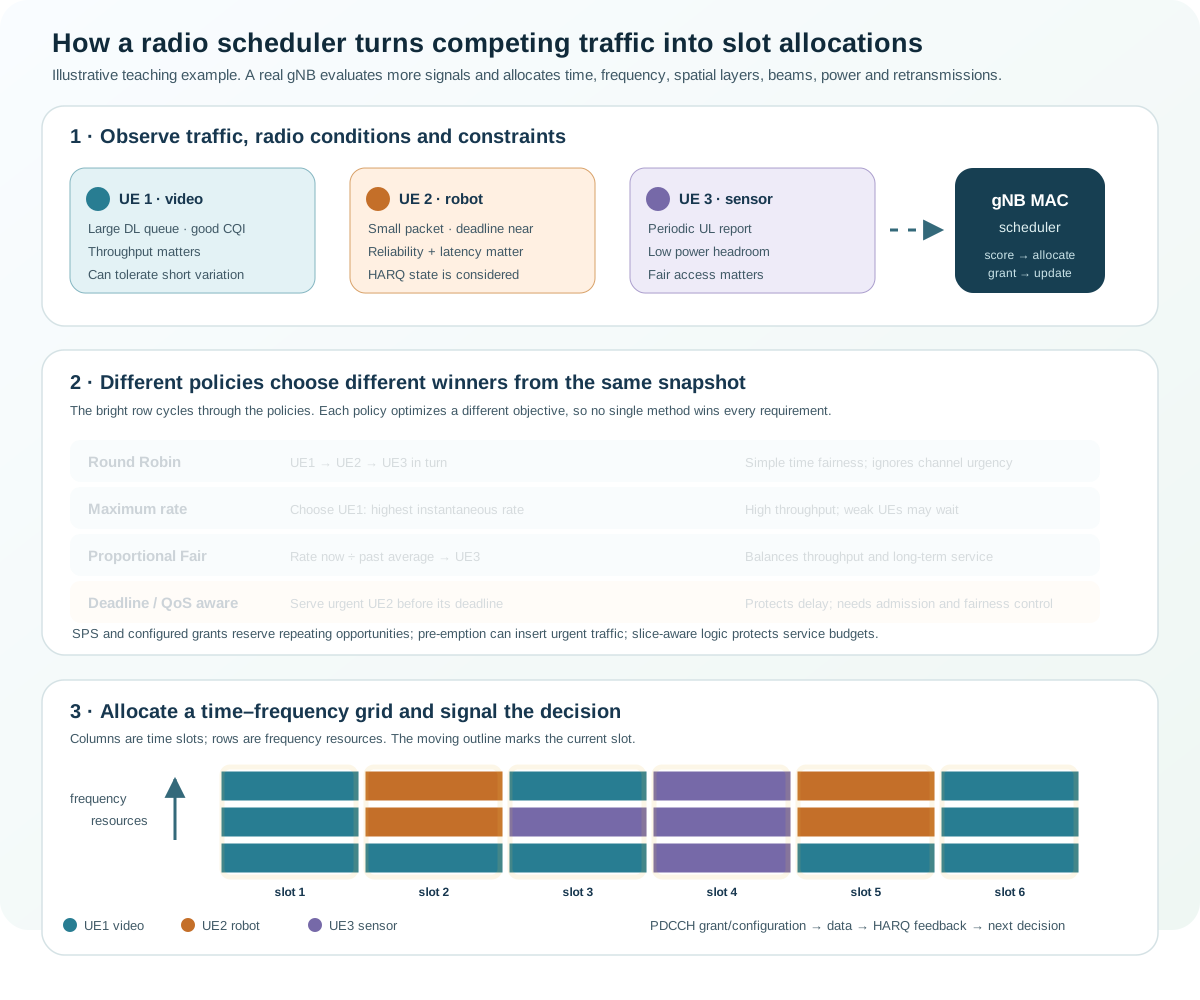
Many users share a limited and changing radio channel. A scheduler is the decision function that converts their queued traffic and radio state into resource assignments. In an NR base station, scheduling is closely associated with MAC operation, but its decisions affect several physical-layer choices.
For each scheduling opportunity, the network may need to decide:
- whether the opportunity is downlink or uplink under the active duplex configuration;
- which UE or UEs may transmit or receive;
- which time and frequency resources they receive;
- which carrier, beam, spatial layer, modulation and coding scheme are used;
- whether a failed block needs HARQ retransmission;
- whether an urgent flow may pre-empt or outrank other traffic.
3GPP defines the messages, measurements, resource structures, QoS information and procedures available to scheduling. It does not prescribe one universal ranking algorithm for every base station. Vendors and researchers can therefore optimize the decision policy while following standardized behaviour at the interfaces.
References for this section3
- ETSI, 3GPP TS 38.300 V17.7.0: NR and NG-RAN Overall Description, MAC scheduling, dynamic resource allocation, buffer status, power headroom, semi-persistent scheduling, configured grants, and pre-emption.
- ETSI, 3GPP TS 38.321 V18.1.0: NR; Medium Access Control Protocol Specification, scheduling requests, buffer status reporting, configured grants, logical-channel prioritization, and MAC procedures.
- ETSI, 3GPP TS 38.211 V15.2.0: NR; Physical Channels and Modulation, NR frame, slot, symbol, and physical-resource structure.
Information Available to the Scheduler
References for this section3
- ETSI, 3GPP TS 38.300 V17.7.0: NR and NG-RAN Overall Description, MAC scheduling, dynamic resource allocation, buffer status, power headroom, semi-persistent scheduling, configured grants, and pre-emption.
- ETSI, 3GPP TS 38.321 V18.1.0: NR; Medium Access Control Protocol Specification, scheduling requests, buffer status reporting, configured grants, logical-channel prioritization, and MAC procedures.
- ETSI, 3GPP TS 23.501 V18.12.0: System Architecture for the 5G System, QoS flows, QoS characteristics, and 5G system service treatment.
Traffic and QoS State
- Downlink queues: the gNB knows how much data is waiting for each bearer or logical channel.
- Uplink Buffer Status Report (BSR): a UE reports how much UL data is buffered, allowing the gNB to estimate the required grant.
- Scheduling Request (SR): a UE can request an UL opportunity when it has data but no suitable grant.
- QoS treatment: priority, packet-delay budget, guaranteed or non-guaranteed bit-rate treatment, and other QoS-flow parameters affect urgency and resource protection.
- Packet age and deadline: implementation logic can track how long data has waited and how much deadline slack remains.
References for this section3
- ETSI, 3GPP TS 38.321 V18.1.0: NR; Medium Access Control Protocol Specification, scheduling requests, buffer status reporting, configured grants, logical-channel prioritization, and MAC procedures.
- ETSI, 3GPP TS 38.300 V17.7.0: NR and NG-RAN Overall Description, MAC scheduling, dynamic resource allocation, buffer status, power headroom, semi-persistent scheduling, configured grants, and pre-emption.
- ETSI, 3GPP TS 23.501 V18.12.0: System Architecture for the 5G System, QoS flows, QoS characteristics, and 5G system service treatment.
Radio and Device State
- CQI/CSI and measurements: estimate supportable link quality, rank, precoding, or beam state.
- Power Headroom Report (PHR): helps avoid an UL allocation that the UE cannot transmit at the required power.
- HARQ feedback: ACK/NACK and retransmission state influence the next allocation.
- Mobility and beam availability: a fast-moving or temporarily blocked user may need a different beam, more robust coding, or recovery resources.
- UE capability: supported bandwidth, carriers, layers, modulation, simultaneous operation, and processing timing constrain valid grants.
- Duplex opportunity: an FDD scheduler has separate UL and DL carriers, while a TDD scheduler must respect which slots or symbols currently permit DL, UL, or flexible use.
The scheduler does not receive perfect future knowledge. Reports are quantized, delayed, and may become stale, so robust decisions matter as much as an ideal mathematical score.
References for this section3
- ETSI, 3GPP TS 38.300 V17.7.0: NR and NG-RAN Overall Description, MAC scheduling, dynamic resource allocation, buffer status, power headroom, semi-persistent scheduling, configured grants, and pre-emption.
- ETSI, 3GPP TS 38.321 V18.1.0: NR; Medium Access Control Protocol Specification, scheduling requests, buffer status reporting, configured grants, logical-channel prioritization, and MAC procedures.
- ETSI, 3GPP TS 38.211 V15.2.0: NR; Physical Channels and Modulation, NR frame, slot, symbol, and physical-resource structure.
The Scheduling Loop
One simplified scheduling cycle is:
- Update state: collect queue arrivals, BSR/SR, QoS timers, channel reports, power headroom, and HARQ results.
- Build candidates: exclude UEs that cannot use the present direction, carrier, beam, timing, or power condition.
- Prioritize or score: apply fairness, rate, deadline, QoS, slice, or policy weights.
- Allocate resources: assign compatible PRBs, symbols, spatial layers, beams, MCS, and HARQ processes.
- Signal or activate the assignment: dynamic grants are indicated through control signalling; configured resources may already be known to the UE.
- Transmit and measure: use PDSCH for scheduled downlink data or PUSCH for scheduled uplink data, then obtain decoding/HARQ feedback.
- Update history: reduce served queues, update average throughput and delay, and repeat with the next opportunity.
The time available for these steps can be very short. Practical schedulers often use staged heuristics rather than solving a large global optimization from scratch for every slot.
References for this section3
- ETSI, 3GPP TS 38.300 V17.7.0: NR and NG-RAN Overall Description, MAC scheduling, dynamic resource allocation, buffer status, power headroom, semi-persistent scheduling, configured grants, and pre-emption.
- ETSI, 3GPP TS 38.321 V18.1.0: NR; Medium Access Control Protocol Specification, scheduling requests, buffer status reporting, configured grants, logical-channel prioritization, and MAC procedures.
- F. Kelly, A. Maulloo, and D. Tan, “Rate control for communication networks: shadow prices, proportional fairness and stability”, Journal of the Operational Research Society, 1998, foundational proportional-fairness analysis.
Main Scheduling Policies
References for this section3
- ETSI, 3GPP TS 38.300 V17.7.0: NR and NG-RAN Overall Description, MAC scheduling, dynamic resource allocation, buffer status, power headroom, semi-persistent scheduling, configured grants, and pre-emption.
- ETSI, 3GPP TS 38.321 V18.1.0: NR; Medium Access Control Protocol Specification, scheduling requests, buffer status reporting, configured grants, logical-channel prioritization, and MAC procedures.
- ETSI, 3GPP TS 23.501 V18.12.0: System Architecture for the 5G System, QoS flows, QoS characteristics, and 5G system service treatment.
1. Round Robin
Round Robin cycles through active users:
Where:
- are the active UEs in the scheduling rotation;
- each arrow indicates the next UE receiving a scheduling turn;
- returning from to starts the next round.
It is simple and gives comparable scheduling opportunities over time. It does not automatically account for different channel rates, packet deadlines, or queue sizes. Equal turns can therefore produce unequal delivered bits and poor latency for urgent traffic.
References for this section3
- ETSI, 3GPP TS 38.321 V18.1.0: NR; Medium Access Control Protocol Specification, scheduling requests, buffer status reporting, configured grants, logical-channel prioritization, and MAC procedures.
- ETSI, 3GPP TS 38.300 V17.7.0: NR and NG-RAN Overall Description, MAC scheduling, dynamic resource allocation, buffer status, power headroom, semi-persistent scheduling, configured grants, and pre-emption.
- ETSI, 3GPP TS 23.501 V18.12.0: System Architecture for the 5G System, QoS flows, QoS characteristics, and 5G system service treatment.
2. Maximum Rate or Maximum C/I
If is the predicted rate for UE at time , a simplified maximum-rate rule is
Where:
- indexes a candidate UE;
- is UE 's predicted achievable rate at time ;
- returns the UE index that gives the largest value;
- is the UE selected for that scheduling opportunity.
This exploits favourable channel conditions and can raise cell throughput. A user at the cell edge or behind an obstruction may repeatedly lose and experience starvation unless the policy includes fairness or minimum-service protection.
References for this section3
- F. Kelly, A. Maulloo, and D. Tan, “Rate control for communication networks: shadow prices, proportional fairness and stability”, Journal of the Operational Research Society, 1998, foundational proportional-fairness analysis.
- ETSI, 3GPP TS 38.321 V18.1.0: NR; Medium Access Control Protocol Specification, scheduling requests, buffer status reporting, configured grants, logical-channel prioritization, and MAC procedures.
- ETSI, 3GPP TS 38.300 V17.7.0: NR and NG-RAN Overall Description, MAC scheduling, dynamic resource allocation, buffer status, power headroom, semi-persistent scheduling, configured grants, and pre-emption.
3. Proportional Fair
A common teaching form divides the instantaneous achievable rate by a smoothed record of past delivered rate:
Where:
- is the selected UE at time ;
- is UE 's instantaneous predicted rate;
- is UE 's smoothed historical throughput;
- is a small positive value that prevents division by zero;
- selects the UE with the largest rate-to-history ratio.
A temporarily strong channel raises the numerator; a user that has received little service has a smaller denominator. The policy balances multi-user throughput with long-term service, but the chosen averaging window and added weights strongly affect behaviour.
References for this section3
- F. Kelly, A. Maulloo, and D. Tan, “Rate control for communication networks: shadow prices, proportional fairness and stability”, Journal of the Operational Research Society, 1998, foundational proportional-fairness analysis.
- ETSI, 3GPP TS 38.321 V18.1.0: NR; Medium Access Control Protocol Specification, scheduling requests, buffer status reporting, configured grants, logical-channel prioritization, and MAC procedures.
- ETSI, 3GPP TS 23.501 V18.12.0: System Architecture for the 5G System, QoS flows, QoS characteristics, and 5G system service treatment.
4. QoS-Weighted Scheduling
A generalized score can combine several needs:
Where:
- is the final scheduling score for UE or flow ;
- is its QoS priority or service weight;
- is its predicted instantaneous achievable rate;
- is its smoothed historical throughput;
- prevents division by zero when historical throughput is very small;
- describes queued data or buffer pressure;
- describes elapsed delay, remaining deadline, or another delay state;
- describes HARQ and reliability state;
- is an implementation-specific function that converts queue, delay, and reliability state into an additional scheduling weight.
A high score increases priority, but it cannot create radio capacity. Admission control and congestion handling are still required.
References for this section3
- ETSI, 3GPP TS 38.321 V18.1.0: NR; Medium Access Control Protocol Specification, scheduling requests, buffer status reporting, configured grants, logical-channel prioritization, and MAC procedures.
- ETSI, 3GPP TS 38.300 V17.7.0: NR and NG-RAN Overall Description, MAC scheduling, dynamic resource allocation, buffer status, power headroom, semi-persistent scheduling, configured grants, and pre-emption.
- F. Kelly, A. Maulloo, and D. Tan, “Rate control for communication networks: shadow prices, proportional fairness and stability”, Journal of the Operational Research Society, 1998, foundational proportional-fairness analysis.
5. Earliest-Deadline-First or Latency-Aware Scheduling
The scheduler can prioritize the packet or flow with the smallest remaining slack:
Where:
- is the remaining deadline slack for flow ;
- is the maximum permitted delivery time;
- is the time already spent waiting or being processed;
- a smaller positive means the deadline is closer; means it has already been missed.
This is useful for control and real-time traffic. Serving only the nearest deadline can waste radio capacity when that UE's channel is extremely poor, and repeated urgent arrivals can starve background traffic. Practical policies combine urgency, reliability, feasibility, and fairness.
References for this section3
- ETSI, 3GPP TS 38.321 V18.1.0: NR; Medium Access Control Protocol Specification, scheduling requests, buffer status reporting, configured grants, logical-channel prioritization, and MAC procedures.
- ETSI, 3GPP TS 38.300 V17.7.0: NR and NG-RAN Overall Description, MAC scheduling, dynamic resource allocation, buffer status, power headroom, semi-persistent scheduling, configured grants, and pre-emption.
- F. Kelly, A. Maulloo, and D. Tan, “Rate control for communication networks: shadow prices, proportional fairness and stability”, Journal of the Operational Research Society, 1998, foundational proportional-fairness analysis.
6. Semi-Persistent Scheduling and Configured Grants
Repeated request-and-grant signalling is inefficient for predictable periodic traffic.
- Semi-Persistent Scheduling (SPS): provides repeating downlink opportunities that can suit periodic media or similar traffic.
- Configured Grant (CG): gives a UE preconfigured uplink occasions, reducing the wait for a dynamic SR/grant exchange. It can support periodic or latency-sensitive UL traffic.
Reserved occasions can be wasted when the source has nothing to send. Multiple devices using shared or contention-based configured resources can also collide, depending on the configuration.
References for this section3
- ETSI, 3GPP TS 38.300 V17.7.0: NR and NG-RAN Overall Description, MAC scheduling, dynamic resource allocation, buffer status, power headroom, semi-persistent scheduling, configured grants, and pre-emption.
- ETSI, 3GPP TS 38.321 V18.1.0: NR; Medium Access Control Protocol Specification, scheduling requests, buffer status reporting, configured grants, logical-channel prioritization, and MAC procedures.
- ETSI, 3GPP TS 23.501 V18.12.0: System Architecture for the 5G System, QoS flows, QoS characteristics, and 5G system service treatment.
7. Pre-emption and Priority Insertion
An urgent transmission may be placed into resources that had been intended for lower-priority data, with the affected receiver informed through the applicable mechanism. This can reduce urgent-packet delay, but excessive pre-emption harms efficiency and the displaced flow. It should be governed by QoS and admission policy rather than used as an unlimited shortcut.
References for this section3
- ETSI, 3GPP TS 38.300 V17.7.0: NR and NG-RAN Overall Description, MAC scheduling, dynamic resource allocation, buffer status, power headroom, semi-persistent scheduling, configured grants, and pre-emption.
- ETSI, 3GPP TS 38.321 V18.1.0: NR; Medium Access Control Protocol Specification, scheduling requests, buffer status reporting, configured grants, logical-channel prioritization, and MAC procedures.
- ETSI, 3GPP TS 23.501 V18.12.0: System Architecture for the 5G System, QoS flows, QoS characteristics, and 5G system service treatment.
8. Slice-Aware and Service-Aware Scheduling
The network can protect resource shares, priorities, or performance objectives across network slices and service classes. The scheduler may first divide a budget between slices and then schedule users inside each slice, or use a joint score. Isolation, utilization, and unused-capacity borrowing need explicit policy.
References for this section3
- ETSI, 3GPP TS 38.300 V17.7.0: NR and NG-RAN Overall Description, MAC scheduling, dynamic resource allocation, buffer status, power headroom, semi-persistent scheduling, configured grants, and pre-emption.
- ETSI, 3GPP TS 38.321 V18.1.0: NR; Medium Access Control Protocol Specification, scheduling requests, buffer status reporting, configured grants, logical-channel prioritization, and MAC procedures.
- ETSI, 3GPP TS 23.501 V18.12.0: System Architecture for the 5G System, QoS flows, QoS characteristics, and 5G system service treatment.
9. AI-Assisted Scheduling
Learning methods can predict traffic, channel evolution, beam blockage, or a useful allocation policy. They remain bounded by standardized signalling and physical constraints. Evaluation should include generalization, inference time, safety constraints, interpretability, and behaviour under rare overload or channel conditions—not only average simulated throughput.
References for this section3
- ETSI, 3GPP TS 38.300 V17.7.0: NR and NG-RAN Overall Description, MAC scheduling, dynamic resource allocation, buffer status, power headroom, semi-persistent scheduling, configured grants, and pre-emption.
- ETSI, 3GPP TS 38.321 V18.1.0: NR; Medium Access Control Protocol Specification, scheduling requests, buffer status reporting, configured grants, logical-channel prioritization, and MAC procedures.
- ETSI, 3GPP TS 38.211 V15.2.0: NR; Physical Channels and Modulation, NR frame, slot, symbol, and physical-resource structure.
How Scheduling Differs in FDD and TDD
References for this section3
- ETSI, 3GPP TS 38.300 V17.7.0: NR and NG-RAN Overall Description, MAC scheduling, dynamic resource allocation, buffer status, power headroom, semi-persistent scheduling, configured grants, and pre-emption.
- ETSI, 3GPP TS 38.321 V18.1.0: NR; Medium Access Control Protocol Specification, scheduling requests, buffer status reporting, configured grants, logical-channel prioritization, and MAC procedures.
- ETSI, 3GPP TS 23.501 V18.12.0: System Architecture for the 5G System, QoS flows, QoS characteristics, and 5G system service treatment.
FDD
Paired DL and UL carriers are simultaneously available. The network can make an independent DL allocation and UL allocation at the same time position. For example, it may send video to UE 1 on the DL carrier while receiving sensor data from UE 3 on the UL carrier. The UE's simultaneous-operation capability, duplex isolation, processing, power, and supported band combination still constrain the choices.
References for this section3
- ETSI, 3GPP TS 38.300 V17.7.0: NR and NG-RAN Overall Description, MAC scheduling, dynamic resource allocation, buffer status, power headroom, semi-persistent scheduling, configured grants, and pre-emption.
- ETSI, 3GPP TS 38.321 V18.1.0: NR; Medium Access Control Protocol Specification, scheduling requests, buffer status reporting, configured grants, logical-channel prioritization, and MAC procedures.
- ETSI, 3GPP TS 23.501 V18.12.0: System Architecture for the 5G System, QoS flows, QoS characteristics, and 5G system service treatment.
TDD
The current pattern first determines the permitted direction. During a DL slot, the scheduler selects downlink users; during an UL slot, it selects uplink users. A packet can wait even when frequency resources appear unused if the next valid opportunity is in the opposite direction. Flexible symbols, guard time, neighbouring-cell coordination, and cross-link interference further constrain allocation.
References for this section3
- ETSI, 3GPP TS 38.300 V17.7.0: NR and NG-RAN Overall Description, MAC scheduling, dynamic resource allocation, buffer status, power headroom, semi-persistent scheduling, configured grants, and pre-emption.
- ETSI, 3GPP TS 38.211 V15.2.0: NR; Physical Channels and Modulation, NR frame, slot, symbol, and physical-resource structure.
- ETSI, 3GPP TS 38.321 V18.1.0: NR; Medium Access Control Protocol Specification, scheduling requests, buffer status reporting, configured grants, logical-channel prioritization, and MAC procedures.
Mixed FDD + TDD Operation
In a layered network, an FDD carrier can maintain coverage and timely bidirectional control while a TDD carrier supplies wider burst capacity. A multi-carrier scheduler can map:
- urgent or coverage-critical packets to the reliable available carrier;
- large DL bursts to a DL-rich TDD capacity layer;
- UL camera or sensing traffic to available TDD UL slots or the FDD UL carrier;
- retransmissions to a carrier and timing that the UE can support.
The scheduler cannot freely move every packet between arbitrary carriers. UE capability, bearer configuration, carrier aggregation or dual-connectivity support, RF coexistence, power limits, and control-plane configuration determine the valid choices.
References for this section3
- ETSI, 3GPP TS 38.300 V17.7.0: NR and NG-RAN Overall Description, MAC scheduling, dynamic resource allocation, buffer status, power headroom, semi-persistent scheduling, configured grants, and pre-emption.
- ETSI, 3GPP TS 38.321 V18.1.0: NR; Medium Access Control Protocol Specification, scheduling requests, buffer status reporting, configured grants, logical-channel prioritization, and MAC procedures.
- F. Kelly, A. Maulloo, and D. Tan, “Rate control for communication networks: shadow prices, proportional fairness and stability”, Journal of the Operational Research Society, 1998, foundational proportional-fairness analysis.
Worked Three-User Example
Assume the network serves:
- UE 1: a large video queue with excellent channel quality;
- UE 2: a small robot-control packet with only of deadline slack;
- UE 3: a periodic sensor report that has received little recent service.
The same instant can lead to different decisions:
| Policy | Likely first choice | Reason | Main risk |
|---|---|---|---|
| Round Robin | The next UE in rotation | Equal turns | May miss UE 2's deadline |
| Maximum rate | UE 1 | Best instantaneous bit rate | UE 2/3 starvation |
| Proportional Fair | Possibly UE 3 | Low historical throughput raises its score | Deadline may need an extra weight |
| Deadline-aware | UE 2 | Smallest remaining slack | Repeated urgent traffic can displace others |
| QoS-weighted PF | UE 2, then UE 1/3 by score | Combines urgency, rate, and service history | Requires careful weights and admission |
A sensible implementation can use several stages: first reserve control and HARQ resources, protect truly urgent feasible packets, then allocate remaining resources with a proportional-fair or slice-aware metric. The exact design depends on the service contract and deployment.
References for this section3
- F. Kelly, A. Maulloo, and D. Tan, “Rate control for communication networks: shadow prices, proportional fairness and stability”, Journal of the Operational Research Society, 1998, foundational proportional-fairness analysis.
- ETSI, 3GPP TS 38.321 V18.1.0: NR; Medium Access Control Protocol Specification, scheduling requests, buffer status reporting, configured grants, logical-channel prioritization, and MAC procedures.
- ETSI, 3GPP TS 23.501 V18.12.0: System Architecture for the 5G System, QoS flows, QoS characteristics, and 5G system service treatment.
How to Evaluate a Scheduler
Peak throughput alone hides poor user experience. Useful measurements include:
- total spectral efficiency and delivered goodput;
- median and fifth-percentile user rate;
- mean, tail, and deadline-miss latency;
- packet loss, BLER, and HARQ retransmissions;
- queue growth and overflow under bursts;
- energy per useful bit and UE power limits;
- slice/QoS objective violations;
- robustness during mobility, blockage, overload, and stale CSI;
- computational time per scheduling decision.
For throughputs , Jain's fairness index is
Where:
- is the measured throughput of UE ;
- is the number of evaluated UEs;
- is Jain's fairness index;
- represents equal measured throughput, while values nearer indicate increasingly unequal allocation.
indicates equal measured throughput, but equality is not automatically the correct QoS outcome: a video stream, robot command, and tiny sensor report do not require equal bit rates. Fairness must be interpreted alongside demand and service objectives.
References for this section3
- ETSI, 3GPP TS 38.300 V17.7.0: NR and NG-RAN Overall Description, MAC scheduling, dynamic resource allocation, buffer status, power headroom, semi-persistent scheduling, configured grants, and pre-emption.
- F. Kelly, A. Maulloo, and D. Tan, “Rate control for communication networks: shadow prices, proportional fairness and stability”, Journal of the Operational Research Society, 1998, foundational proportional-fairness analysis.
- ETSI, 3GPP TS 38.321 V18.1.0: NR; Medium Access Control Protocol Specification, scheduling requests, buffer status reporting, configured grants, logical-channel prioritization, and MAC procedures.
Takeaway
Duplexing determines which direction can use a resource; scheduling decides which user and traffic receive that usable resource. Round Robin emphasizes simple turns, maximum-rate emphasizes instantaneous capacity, proportional-fair balances rate with service history, and deadline/QoS-aware methods protect time-sensitive flows. SPS, configured grants, pre-emption, slice logic, and learning-assisted prediction address particular traffic structures. A practical scheduler combines these ideas while respecting radio, device, duplex, QoS, and signalling constraints.
References for this section3
- ETSI, 3GPP TS 38.300 V17.7.0: NR and NG-RAN Overall Description, MAC scheduling, dynamic resource allocation, buffer status, power headroom, semi-persistent scheduling, configured grants, and pre-emption.
- ETSI, 3GPP TS 38.321 V18.1.0: NR; Medium Access Control Protocol Specification, scheduling requests, buffer status reporting, configured grants, logical-channel prioritization, and MAC procedures.
- ETSI, 3GPP TS 23.501 V18.12.0: System Architecture for the 5G System, QoS flows, QoS characteristics, and 5G system service treatment.
Complete references and further reading
- ETSI, 3GPP TS 38.300 V17.7.0: NR and NG-RAN Overall Description, MAC scheduling, dynamic resource allocation, buffer status, power headroom, semi-persistent scheduling, configured grants, and pre-emption.
- ETSI, 3GPP TS 38.321 V18.1.0: NR; Medium Access Control Protocol Specification, scheduling requests, buffer status reporting, configured grants, logical-channel prioritization, and MAC procedures.
- ETSI, 3GPP TS 23.501 V18.12.0: System Architecture for the 5G System, QoS flows, QoS characteristics, and 5G system service treatment.
- ETSI, 3GPP TS 38.211 V15.2.0: NR; Physical Channels and Modulation, NR frame, slot, symbol, and physical-resource structure.
- F. Kelly, A. Maulloo, and D. Tan, “Rate control for communication networks: shadow prices, proportional fairness and stability”, Journal of the Operational Research Society, 1998, foundational proportional-fairness analysis.