Why Divide a Wideband Signal?
Imagine one fast signal crossing a city. The direct wave and delayed reflections overlap; different parts of the band can fade differently.
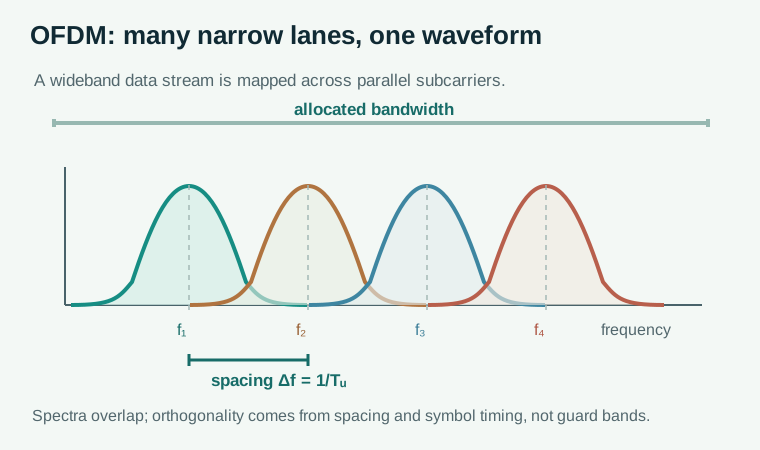
- Subcarriers are narrow frequency lanes inside the allocated band. Each carries a slower stream of symbols, so the channel often looks approximately flat across one lane.
- OFDM transmits many such lanes at once. Their frequencies are chosen to be orthogonal over the useful symbol interval, allowing dense packing without ideal cross-talk when timing and frequency synchronization hold.
- FFT/IFFT are efficient ways to separate and combine the lanes. An IFFT creates the time-domain transmit symbol; a receiver FFT recovers its subcarrier values.
- Cyclic prefix (CP) copies the end of each OFDM symbol to its beginning. When the important delayed paths fit within the CP and synchronization is adequate, per-subcarrier equalization becomes much simpler.
For orthogonal subcarriers:
- : spacing between adjacent subcarrier centres, in hertz.
- : useful OFDM symbol duration, excluding the cyclic prefix, in seconds.
- Trade-off: OFDM simplifies per-subcarrier equalization but adds CP and pilot overhead; high waveform peaks and frequency offset also need attention.
References for this section3
- MathWorks, OFDM Resource Grid and Channel Estimation.
- MathWorks, OFDM Demodulation.
- MathWorks, Block Codes.
Worked Example: The Subcarrier Trade-off
For a simplified 20 MHz sampled band and 1024-point FFT:
- Bin spacing: kHz.
- Useful symbol time: about .
- 5 s CP overhead: of symbol time.
- Trade-off: longer CP tolerates more delay but leaves less time for new data. These are teaching values, not an NR numerology.
References for this section3
- MathWorks, OFDM Resource Grid and Channel Estimation.
- MathWorks, OFDM Demodulation.
- MathWorks, Block Codes.
What Is a Pilot?
A pilot is a transmitted symbol whose complex value the receiver knows in advance. It occupies an ordinary time-frequency cell.
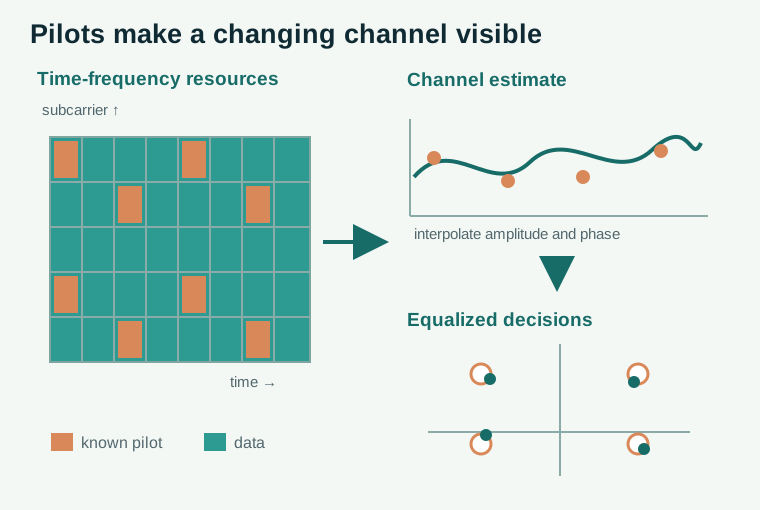
- What it reveals: comparing a received pilot with its known transmitted value estimates the channel's amplitude and phase at that grid location.
- Why several are needed: the channel can differ across subcarriers and can change from one OFDM symbol to the next.
- What happens between pilots: interpolation estimates the channel at data cells. Widely spaced pilots can miss a rapidly varying channel.
- The cost: pilots occupy time-frequency resources that could otherwise carry data; more pilots are not free.
For one subcarrier in a simplified flat channel,
- : transmitted symbol on subcarrier .
- : complex channel gain on that subcarrier.
- : received symbol; : noise or unmodelled disturbance.
- : subcarrier index.
At a known, nonzero pilot, a simple estimate is:
- : estimated channel on subcarrier .
- : known transmitted pilot; : received pilot.
- Assumption: timing and frequency synchronization are good enough that subcarriers do not strongly leak into each other.
References for this section3
- MathWorks, OFDM Resource Grid and Channel Estimation.
- MathWorks, OFDM Demodulation.
- MathWorks, Block Codes.
From Samples to Decoded Data
- Synchronize: locate symbol timing and correct carrier-frequency/phase offset. Residual frequency offset rotates phase by over time and can leak energy between subcarriers.
- Transform: remove the CP and use the FFT to inspect each subcarrier.
- Estimate: compare pilots against known values, then interpolate across data cells.
- Equalize and detect: compensate for the estimated channel and choose likely transmitted symbols.
- Decode: use coding redundancy to recover bits; evaluate errors and latency, not just a clean-looking constellation.
- Steady constellation rotation: check residual carrier-frequency offset.
- Sudden phase jump: check tracking and synchronization.
- Shifted timing peak: test multipath, not only an ideal channel.
References for this section3
- MathWorks, OFDM Resource Grid and Channel Estimation.
- MathWorks, OFDM Demodulation.
- MathWorks, Block Codes.
Worked Example: Why a Fade Hurts Equalization
Use a noise-free toy channel to follow one symbol:
- Transmit a known pilot ; receive . The estimate is .
- Transmit data ; receive . Divide by to recover .
- Now let the channel fall to . Division multiplies additive noise by 20 in amplitude. An exact inverse is fragile near a deep fade.
- MMSE equalizer: uses estimated noise power to limit amplification near a fade, while allowing some residual distortion.
- Evaluation: compare post-equalization EVM and decoded BLER, not only a noiseless inverse.
References for this section3
- MathWorks, OFDM Resource Grid and Channel Estimation.
- MathWorks, OFDM Demodulation.
- MathWorks, Block Codes.
Equalization and Decisions
- Zero forcing: divides by the channel estimate; simple, but can amplify noise badly near fades.
- MMSE: balances channel correction and noise enhancement; depends on a useful noise estimate.
- Detection: assigns received points to likely modulation symbols.
- Channel decoding: uses redundancy to recover bits. More redundancy improves robustness but reduces the fraction of transmitted bits carrying new information.
| Processing stage | Failure you may see | Useful diagnostic |
|---|---|---|
| Synchronization | Rotating or smeared constellation | Timing and frequency-offset estimates |
| Channel estimation | Wrong amplitude/phase correction | Pilot residuals or channel-estimation MSE |
| Equalization | Noise amplification in faded subcarriers | Post-equalization SINR and EVM |
| Detection/decoding | Wrong bits or failed blocks | BER and BLER at the chosen modulation/coding |
- Beamforming: combines antenna-port signals with spatial weights; see phase control.
- Evaluation: choose a measurement point and outcome using the performance guide.
References for this section3
- MathWorks, OFDM Resource Grid and Channel Estimation.
- MathWorks, OFDM Demodulation.
- MathWorks, Block Codes.
Application: A Moving mmWave User
A narrow beam can supply strong received power, yet a moving user's channel estimate ages:
-
Fast motion: pilots, phase tracking, and beam updates may need to occur more often.
-
Resource trade-off: additional pilots improve tracking but leave fewer cells for data.
-
Receiver trade-off: more complex equalization may improve BLER but add computation and latency.
-
Success criterion: judge delivered data and reliability under motion, not pilot MSE alone.
-
Beyond decoding: pilot observations can carry delay, angle, and Doppler information.
-
Keep: raw or calibrated complex samples for sensing/localization; bit-only receiver outputs can discard that information.
References for this section3
- MathWorks, OFDM Resource Grid and Channel Estimation.
- MathWorks, OFDM Demodulation.
- MathWorks, Block Codes.
Complete references and further reading
- MathWorks, OFDM Resource Grid and Channel Estimation.
- MathWorks, OFDM Demodulation.
- MathWorks, Block Codes.